

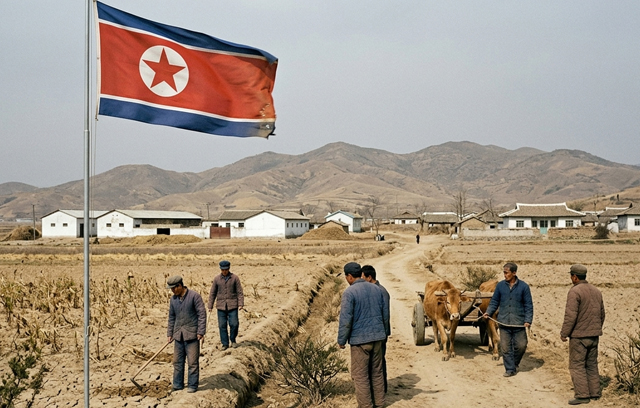
The North Korea drought of 2026 is emerging as one of the most serious agricultural crises the country has faced in recent years. Reports from South Korean news agency Yonhap indicate that the dry spell is putting staple grain crops under severe pressure. Furthermore, the timing of the crisis is particularly alarming, as it coincides directly with the critical spring planting season. Therefore, food security concerns for the country are intensifying rapidly.
Prime Minister Inspects Provinces Hit by North Korea Drought
North Korean Prime Minister Pak Thae Song visited the provinces of Pyongannam-do and North Hwanghae to assess local authorities’ efforts to combat the unprecedented drought that has hit the country, Yonhap reported on Thursday.
“Pak Thae Song inspected key agricultural areas in the provinces of Pyongannam-do and North Hwanghae to assess the prospects for the wheat and barley harvests and discussed measures to prevent crop damage with local officials,” the agency wrote.
Emergency Irrigation Measures and Harvest Preservation Efforts
In response to the crisis, authorities have deployed emergency resources to affected farming regions. Authorities dispatch water trucks daily to rural areas to improve irrigation of large crop fields. Additionally, authorities are making efforts to preserve the harvest that was gathered before the drought took hold.
However, the situation is further complicated by the timing of the dry spell. Specifically, the drought hit the country just before the spring rice planting season. Consequently, if moisture levels do not recover soon, the impact will extend well beyond the current wheat and barley crops and threaten the upcoming rice season as well.
North Korea’s Chronic Food Deficit: 19 Consecutive Years on the FAO List
Beyond this immediate crisis, the broader context of food insecurity in North Korea is deeply concerning. Yonhap recalls that North Korea has been on the list of food-deficit countries requiring external assistance — compiled by the Food and Agriculture Organization of the United Nations — for 19 consecutive years. As a result, any additional disruption to domestic grain production risks further worsening an already fragile food situation for millions of people across the country.
Source: Zerno On-Line (Russia)